The word “organic” has a powerful effect on purchase decisions. It sounds cleaner, more natural, more trustworthy. And when it comes to organic olive oil, the instinct is usually right, but not for the reasons most people assume. Certification matters. But it is not the whole story, and for olive oil in particular, it is not even the most important part.
This article explains exactly what the organic label guarantees, what it does not, and what you should look for if you want a genuinely superior extra-virgin olive oil on your kitchen counter.
What Organic Certification Actually Requires
Organic certification for olive oil is primarily about how the grove is managed. To be certified organic, producers must:
- Eliminate synthetic pesticides, herbicides, and fertilisers from the grove.
- Use only approved organic inputs: compost, natural pest control, and chemical-free soil management.
- Maintain certified status for a transition period, typically three years, before their oil can carry the label.
- Submit to annual third-party inspections of the grove, the mill, and the supply chain.
What certification does not regulate: the method of extraction, the temperature at which the oil is pressed, the free acidity level, the freshness of the olives at harvest, or whether the oil is genuinely extra virgin olive oil. You can produce a certified organic oil that is pressed hot, stored badly, and bottled months after harvest, and it would still carry the label.
Key Takeaway
Organic = how the grove was farmed; Extra virgin = how the oil was extracted; You need both. Neither alone is enough.
Organic vs Conventional: What the Research Shows
Numerous studies have shown that organic olive oil contains higher levels of polyphenols and antioxidants than conventionally grown olive oil from the same region. The reason? Stress: Organic olive trees, cultivated without synthetic inputs, react to their environment by producing more protective compounds. These compounds then end up in the oil.
This directly explains the benefits of olive oil that make it an essential element of the Mediterranean diet: its anti-inflammatory and cardiovascular properties are primarily due to polyphenols. The higher the polyphenol content, the greater the benefits per tablespoon.
Note: Polyphenol content varies considerably depending on the olive variety, harvest time, and extraction method. A high-quality, conventionally produced, first cold-pressed EVOO from a conscientious producer can outperform a lower-quality organic oil. The cultivation method is just one factor among many.
Why Tunisia Is Already Ahead of the Label
Here is something worth understanding about Tunisian olive oil: traditional Tunisian farming practices have, for centuries, aligned closely with what we now call organic principles, not because of certification requirements, but because of how these groves were always managed. Many Tunisian producers use minimal inputs by default, rely on dry-farming techniques, and work with ancient olive varieties that have adapted to their environment without industrial support.
Certification is becoming increasingly accessible and important for export markets, and DOCCANA offers certified organic expressions in its range, but the underlying commitment to low-intervention agriculture exists in much of the Tunisian supply chain, whether the label is present or not.
Did You Know?
Tunisia has approximately 86 million olive trees. Many Tunisian olive groves are centuries old, some over 2,000 years old. The Chetoui and Chemlali varieties, native to Tunisia, are naturally drought-resistant. Tunisian extra virgin olive oil has won numerous awards at the world’s most prestigious olive oil competitions.
How to Read the Full Picture on a Label
When choosing an organic olive oil, consider certification as a starting point, not an end in itself. Then, look for:
- Harvest date: The single most important freshness signal. EVOO degrades over time. Look for an oil within 12–18 months of its harvest date.
- Free acidity: True extra virgin olive oil has a free acidity of 0.8% or less. The best premium oils are often under 0.4%.
- Country and region of origin: Single-origin oils, from a single region or orchard, offer better consistency and traceability than blended oils from multiple countries.
- Extraction method: Cold-pressed or first cold press means the oil was extracted at temperatures below 27°C, preserving flavour and nutrients.
- Packaging: Dark glass or tin. Clear plastic or light-exposed bottles will compromise quality regardless of what the label says.
DOCCANA’s Organic Range
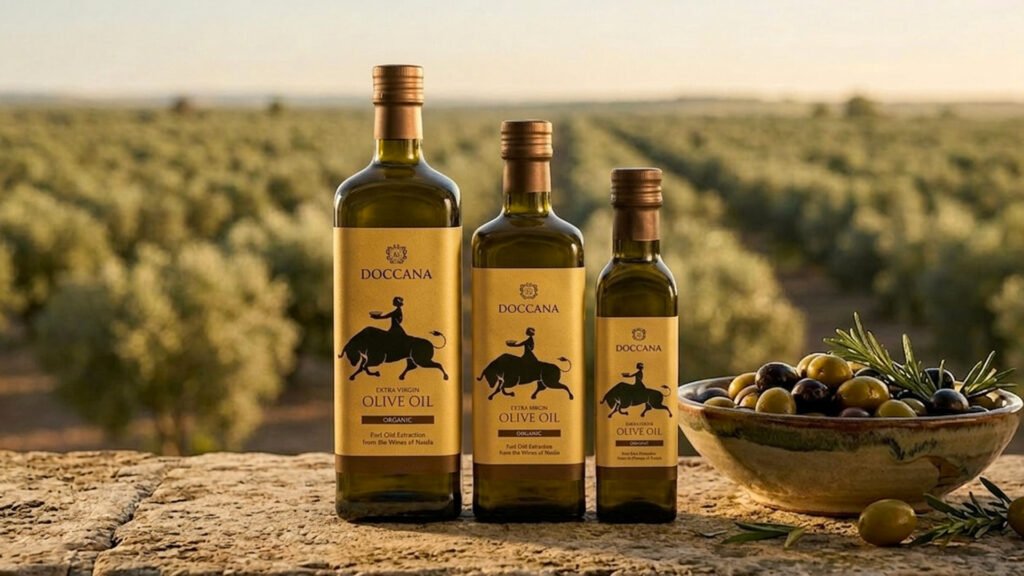
DOCCANA’s certified organic extra virgin olive oil is cold-pressed from Tunisian groves that meet full certification requirements; third-party verified, with the harvest date on every bottle. It sits alongside our classic expression in the collections range because we believe the choice between organic and conventional should be an informed one, not a default.
Browse the full range of our olive oil collections and find the expression that fits your cooking and your values. Our certified organic EVOO is cold-pressed, third-party verified, and carries the harvest date on every bottle. Our Premium Organic EVOO 250ml is available now — cold-pressed from Chetoui olives and delivered across the UAE.
Frequently Asked Questions
Is organic olive oil healthier than regular olive oil?
Research shows organic olive oil tends to contain higher polyphenol levels than conventionally farmed equivalents. Polyphenols drive most of the health benefits of EVOO, including anti-inflammatory effects, cardiovascular protection, and antioxidant activity. However, organic certification alone does not guarantee quality. A fresh, cold-pressed conventional EVOO can outperform a poorly made organic oil. You need both organic farming and proper cold-press extraction.
Does organic mean extra virgin?
No. Organic and extra virgin are separate certifications entirely. Organic describes how the grove was farmed. Extra virgin describes how the oil was extracted. Always look for both on the label.
What should I look for on an organic olive oil label?
Four things: an organic certification mark, an extra virgin designation, a harvest date within the last 12 to 18 months, and a single country of origin. Free acidity stated below 0.8% is a strong quality signal. No harvest date means the producer is not being transparent about freshness.
Explore DOCCANA’s Certified Organic Olive Oil
Cold-pressed · Tunisian origin · Harvest date on every bottle
Shop the Olive Oil Collections.